How Wind-Driven Rain Finds Its Way Under Roof Tiles
Wind-driven rain gets under roof tiles when wind lifts tile edges, forces water past broken tiles, and pushes it through failed underlayment and open flashings.
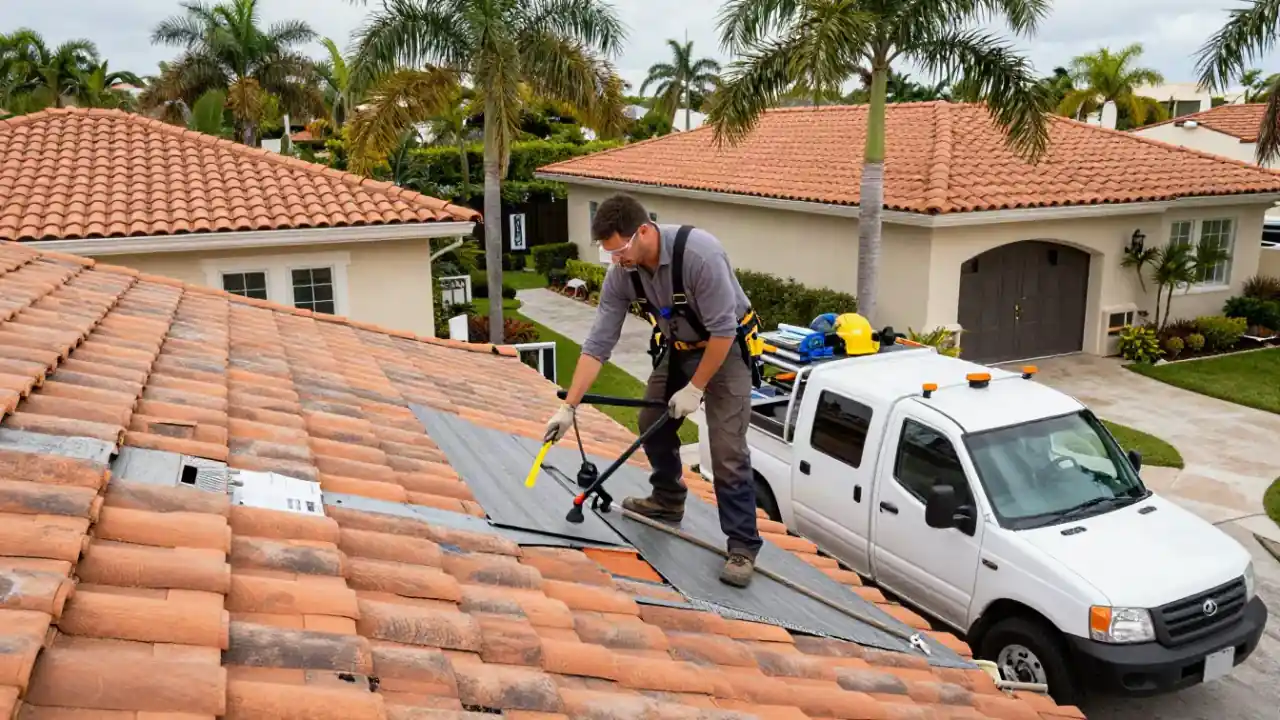
Wind-driven rain gets under roof tiles when wind lifts the edges of a tile, pushes water sideways past the interlocking channels, and forces it through any gap in the underlayment, flashing, or fasteners below. In Delray Beach, that process happens fast because our summer storms routinely drive rain at 40 to 60 mph from the east and southeast, nearly parallel to the roof slope. A tile roof that sheds a straight-down afternoon shower without a drop can leak in five minutes under that kind of sideways pressure.
We are Delray Beach Tile Roof Repair, and we have climbed enough of these roofs to know that the leak almost never starts where the stain shows up on your ceiling. This post walks through the exact paths wind-driven rain takes under tile, why the damage is easy to miss until it is expensive, and what you can check yourself before you call anyone.
How Wind-Driven Rain Gets Under Roof Tiles in Delray Beach
How wind-driven rain gets under roof tiles is a pressure problem, not a gravity problem. When wind hits a roof at an angle, it creates positive pressure on the windward slope and negative pressure on the leeward side. That pressure difference pulls water uphill and sideways into every opening it can find. On a calm day, water runs down the tile channels and off the eave. On a storm day, water is being pushed into the roof from three directions at once.
Tile roofs are designed as a two-layer system. The tile is the first line of defense, but it is not waterproof on its own. The actual waterproofing is the underlayment beneath it. When wind-driven rain gets past the tile, the underlayment has to catch it and channel it to the eave. If the underlayment is old, torn, or improperly lapped, the water goes straight into your attic.
We see this constantly on homes across Tile Roof Repair in Pineapple Grove, where a mix of older concrete tile and newer barrel tile sits on roofs that have been through 15 to 25 hurricane seasons. The tile still looks fine from the street. The underlayment underneath is what fails.
If you want the full picture of how we diagnose and fix these leaks, our Tile Roof Repair Delray Beach FL page covers the whole process from inspection to final water test.
Why Your Tile Roof Leaks During Heavy Rain and Not Light Rain
Your tile roof leaks during heavy rain because heavy rain comes with wind, and wind is what turns a minor roof defect into an active leak. A cracked tile or a lifted flashing edge can sit there for months without letting in a drop. Add 50 mph wind and two inches of rain in an hour, and that same defect becomes a steady drip into your living room.
There are three reasons this happens:
- Wind pressure pushes water uphill. Water that would normally run off the eave gets pushed back up the roof slope and into gaps that face the wind.
- Volume overwhelms the drainage path. A tile channel that handles a light rain fine can overflow when the rain rate hits two or three inches per hour.
- Capillary action pulls water sideways. Water can wick through a gap as narrow as 1/16 of an inch, which is why a hairline crack in a tile or a slightly lifted flashing edge matters more than it looks.
That is also why a roof that passed a visual inspection in March can leak in July. The defect was always there. The wind is what activated it.
The Four Entry Points Wind-Driven Rain Uses
Wind-driven rain uses four main entry points on a tile roof, and in our experience, most leaks trace back to one of them. Knowing which one you are dealing with tells you what the repair will involve.
1. Lifted or Broken Tile Edges
When wind gets under the leading edge of a tile, it lifts it. Once that tile is up even a quarter inch, water pours into the channel beneath it. Repeated lifting loosens the fasteners and eventually cracks the tile. On roofs we inspect after a storm, we typically find 5 to 20 lifted or cracked tiles on the windward slope alone.
Fixing this is not just replacing the tile. The underlayment beneath it has to be checked too, because water has been running through that gap for who knows how long. Our Broken and Cracked Tile Repair Delray Beach FL service handles both the tile and the layer underneath it.
2. Failed Underlayment
Underlayment is the real roof. It is a felt or synthetic membrane that sits between the tile and the deck. In South Florida, a standard 30-pound felt underlayment lasts about 15 to 20 years before it starts to dry out, tear, and lose its water-shedding ability. A synthetic underlayment can last 25 to 30 years, but only if it was installed correctly.
Once the underlayment is compromised, wind-driven rain goes straight through. You will see water stains on the ceiling, damp insulation, and sometimes mold within a week. Replacing it means pulling the tile, laying new underlayment, and resetting the tile. It is a big job, but it is the only real fix. We do this work under Underlayment Replacement Delray Beach FL.
3. Flashing and Valley Failures
Flashing is the metal that seals the joints where the roof meets a wall, a chimney, a vent, or another roof plane. Valleys are the V-shaped channels where two roof slopes meet. Both are high-stress areas in wind-driven rain because water is being pushed directly against them.
Flashing fails in two ways: the sealant dries out and cracks, or the metal itself lifts and pulls away from the wall. Either way, water gets behind it. Valley failures are usually a sign that the underlayment in the valley has worn through. We repair both under Flashing and Valley Repair Delray Beach FL.
4. Ridge and Hip Tile Gaps
Ridge tiles run along the top of the roof. Hip tiles run down the corners. Both are held in place with mortar or foam, and both take the full force of wind from every direction. When the mortar cracks or the foam breaks down, the tile shifts. That opens a gap that wind-driven rain can exploit.
On a roof we inspected in Delray Beach last spring, six ridge tiles had shifted by more than an inch. The homeowner had no idea until water started dripping down a bedroom wall. Re-securing ridge and hip tiles is a relatively quick fix if you catch it early. We handle it under Ridge and Hip Tile Re-Securing Delray Beach FL.
Why South Florida's Storm Pattern Is Hard on Tile Roofs
South Florida's storm pattern is hard on tile roofs because our rain almost always arrives sideways. Between June and November, afternoon thunderstorms build over the Everglades and push east toward the coast. By the time they reach Delray Beach, they are often packing 40 to 60 mph gusts and rain rates of two to three inches per hour.
That is a completely different kind of rain than what falls in most of the country. A roof in Atlanta might see 50 inches of rain a year, but most of it falls straight down. A roof in Delray Beach sees 60 to 65 inches, and a large share of it is driven horizontally by wind.
Add the salt air and the UV index, and you have a roof that ages faster than the same roof would 30 miles inland. Sealants dry out quicker. Metal flashing corrodes faster. Underlayment that would last 20 years in Orlando might last 15 here.
We see the results of this every week in neighborhoods like Tile Roof Repair in Tropic Isle, where homes sit close to the Intracoastal and take the full brunt of east wind off the water. The roofs there need more frequent inspection than the ones a few blocks west.
What to Watch Out For After a Wind-Driven Rain Event
After a wind-driven rain event, the damage is not always obvious from the ground. Here is what we tell homeowners to check, in order of urgency:
- Water stains on ceilings or walls. A brown ring on the drywall means water has been getting in for a while. It does not always appear directly under the leak; water can travel along rafters before it drips.
- Granules in the gutter or at the downspout. If you see piles of sandy material after a storm, that is underlayment breaking down. It is one of the earliest signs that the waterproofing layer is failing.
- Lifted or missing tiles. Walk your yard and look up at the roof from a few angles. If you see tiles that are out of line or gaps where tiles should be, that is wind damage.
- Cracked or crumbled mortar at the ridge. Get binoculars and look at the top of the roof. If the mortar between ridge tiles is cracked or missing, water is getting in.
- Damp attic insulation. If you can safely get into the attic, look for dark or compressed insulation. That is a sign of a slow leak that has been running for weeks.
If you find any of these, do not wait for the next storm to make it worse. A small repair now is almost always cheaper than a full underlayment replacement later.
When to Call a Professional
Call a professional when you see water inside the house, when you find more than two or three damaged tiles, or when you cannot safely get on the roof to check. Tile roofs are heavy and slippery, especially after rain. A fall from a two-story roof is not worth the savings on a DIY repair.
We handle Tile Roof Leak Repair Delray Beach FL for homeowners across the city, and we start every job with a full inspection so we know exactly where the water is coming in. If you are not sure whether you have a problem, we can tell you in 30 minutes.
We also work in the neighborhoods around Tile Roof Repair in Del-Ida Park, where the older homes often have original tile and underlayment that is past its service life.
Frequently Asked Questions
How does wind driven rain get under roof tiles in Delray Beach?
Wind-driven rain gets under roof tiles when wind pressure lifts tile edges, pushes water sideways past the interlocking channels, and forces it through gaps in the underlayment, flashing, or ridge mortar. In Delray Beach, storms routinely drive rain at 40 to 60 mph, which is enough to push water uphill and into any opening.
Why does my tile roof leak during heavy rain in Delray Beach FL?
Your tile roof leaks during heavy rain because heavy rain comes with wind, and wind activates defects that stay dry in light rain. A cracked tile, a lifted flashing edge, or a worn spot in the underlayment can sit dormant for months. Add 50 mph wind and two inches of rain, and it becomes an active leak.
How do I stop wind driven rain leaks in South Florida?
You stop wind-driven rain leaks by fixing the underlayment, flashing, and tile fasteners, not just the tile surface. The tile is the first layer, but the underlayment is what actually keeps water out. If your underlayment is more than 15 to 20 years old, replacement is usually the only permanent fix.
Can wind driven rain damage roof tiles in Delray Beach?
Yes. Wind-driven rain damages roof tiles by lifting them, cracking them, and loosening the fasteners that hold them down. Once a tile is lifted, water gets underneath and the damage spreads. After a major storm, we typically find 5 to 20 damaged tiles on the windward slope of an average Delray Beach roof.
How much does tile roof leak repair cost in Delray Beach in 2026?
Typical 2026 pricing in this area runs $350 to $900 for a small leak repair, $1,200 to $3,500 for flashing or valley work, and $8,000 to $18,000 for a full underlayment replacement on a standard home. The final number depends on roof size, tile type, and how much damage the water has already done.
Get Help with Tile Roof Repair in Delray Beach
If wind-driven rain has found its way under your tile roof, we can find the entry point and fix it before the next storm. We inspect, repair, and water-test every roof before we leave.
Call Delray Beach Tile Roof Repair at (561) 342-0635 to schedule your inspection.